Over the years, communities in Africa have been seen to evolve. Without dispute, it is visible in common social examples as people’s preferences, trends, behavior patterns, lifestyles and that change in general forces them to move.
The preceding phenomena also factors in the rapid nature of mobility due climate change in an array of other causative factors like urbanization and technology. As housed in the Africa Climate Mobility Initiative ‘Africa Shifts Report’ 48.5% of the analyzed young Africans still did not consider moving despite threats from the changing climate situation. This and data of the like highlight the need to then build resilience and capacities conducive to house the thriving of these young people in their homeland. Several benefits are hemmed within the process. Grounds for more innovation are augmented, labor is transformed into more fluidity and flexibility, and cultures are integrated in the continent. All preceding instances expedite more development opportunities for people in those respective communities.
As commensurate as it is to the sound, the evolution, as mentioned earlier, stems from important underlying social, political and economic factors that influence and determine how that evolution will be.
In recent years migration in Africa has been induced by slow-onset climate events such as droughts, desertification, deforestation, water scarcity, rising sea levels, and coastal erosion. All have increased in occurrence and severity over the last few decades due to the effects of climate change.
A lot has been cited regarding the incalculable nature of mobility in Africa, even to a great degree with the ongoing global climate crisis. The continent has a mission to evolve simultaneously against pre-existing barriers and the unprecedented effects of climate change; as young as the African continent is, young people are victims of climate-induced migration but can also be a catalyst or solution to the problem.
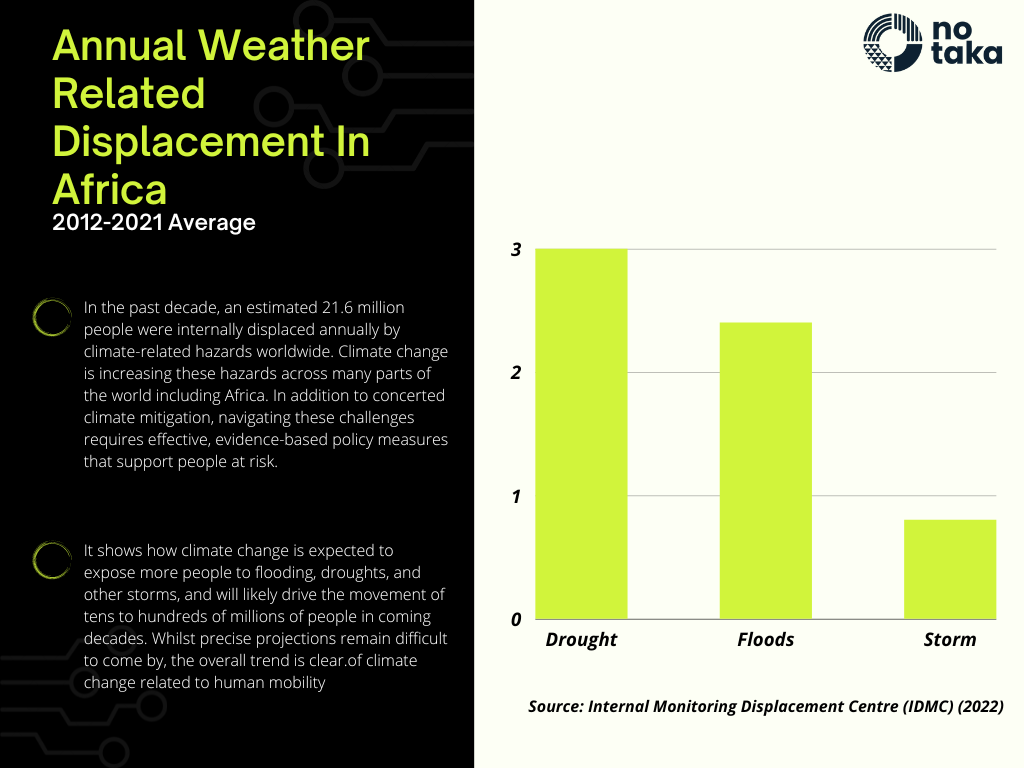
Annual weather-related displacements in millions (2012 – 2021 (average)-Africa
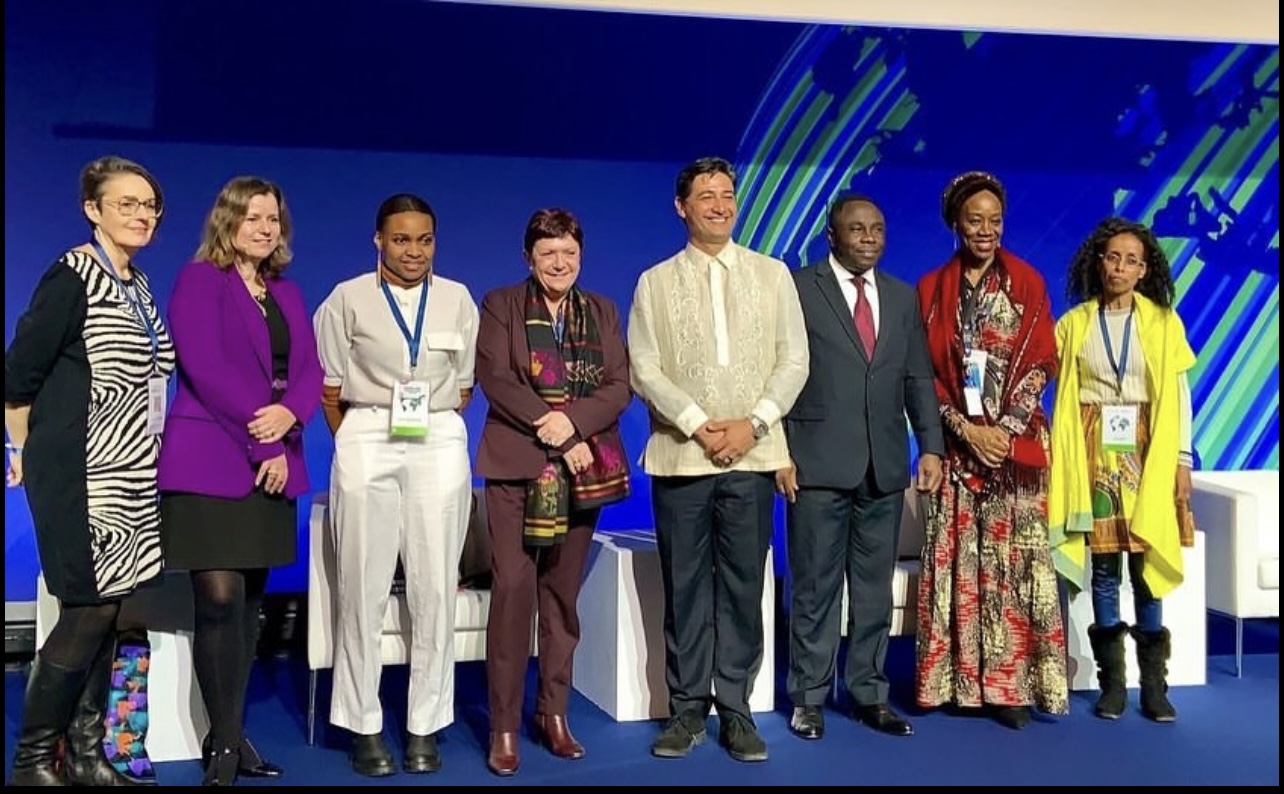
These foundational thoughts pushed my mind into unpacking the issue of climate mobility differently in the African context after attending 1st week of discussions and information-sharing sessions at the 27th United Nations Framework Convention on Climate Change in Sharm El Sheikh, Egypt.
To my army of young people, how about we converse about two contextual issues in Africa that can also be part of the solution to climate-induced mobility challenges and how congruent the issues are to the youth.
Data and Mobility
Holistic approaches to undertaking local research that examines the intersectional linkages of climate mobility and other social-political issues should be prioritized. Climate mobility is not a stand-alone issue, and looking at it as an independent challenge does not suffice enough information for sustainable solutions. Data available and discussed is mostly on climate-induced mobility effects but not causative factors.
The term ‘data’, as used often during the UNFCCC CoP27 conversations, should be backed by concrete plans on how it can be attained and applied.
Investing in young people to learn data science skills and knowledge can make them contributors to climate mobility data pools and hasten the data integration process in the region. I.e. As more scholarships are given for engineering studies, the same should be done for data scientists in the climate mobility space.
With 70% of sub-Saharan Africans under 30, young people in Africa have the power and strength to drive agendas in the media. Governments and other development stakeholders can use this power to set climate mobility data as a primary agenda and influence action around it.
Due to the climate-induced mobility urgency, informal data collection channels can also be used under verification mechanisms, i.e. indigenous knowledge, cross-border entities and local community authorities. Let data sources not only be chained down to scientific tools and internationally accredited institutions but diversified.
Lastly, how data is communicated should be reviewed, especially to grassroots communities. New media has the transformative power to remake how we share data with local communities. The synergy between data, information and interactive storytelling should be inquisitively explored.
Regional Integration & Free Movement
The enactment of ‘managed migration systems’ in Africa can be an excellent junction to explore as a solution for climate mobility challenges and an adaptation strategy for host communities. Due to the unstable nature of relationships between countries in Africa, managed migration can serve as a short-term intervention with permanent approaches, i.e. settlements, to create an avenue for free movement to come about gradually as trust is built between nations.
An array of current data by different stakeholders, including the World Bank (World Bank 2011, p.33), denote that most mobility activity falls under regional scopes. From the above petition, leveraging regional integration as a comprehensive multilateral strategy for planned migration is only strategic.
Regional corporations grant opportunities that harmonize tense situations among countries and help influence countries’ adaptive capacity to different development agendas like free movement. They can be used as instruments of liberalization at the regional level, erasing irregular patterns of migration, which may also result in further repercussions like human trafficking.
Separate from catalyzing socio-economic development and maximizing opportunities for young people, the free movement offers Africa the rare opportunity to act upon common challenges like climate-induced migration with collective power. Free movement can widen spaces for trade and labor markets. Tourism, easened demographic pressure and cultural integration are among the additional margins to the benefits of free movement in Africa.
Our envisioned future communities engraved in the Africa Agenda 2063 can be realized under coherent frameworks marrying mitigation and adaptation strategies against climate-induced mobility. Strategies that create spaces and support young people’s development.
Pitch 01
In recent years migration in Africa has been induced by slow-onset climate events such as droughts, water scarcity, rising sea levels etc. All have increased in occurrence and severity over the last few decades due to the effects of climate change. Young Africans have been negatively impacted by the situation in ways such as being exposed to latent conflict and threatened human security concerns due to scarcity of resources, shrinking employment opportunities that affect income and financial flows which all are gripped in the abstract policy/legal climate frameworks that lack inquisitive implementation and inclusive strategies.
As housed in the Africa Climate Mobility Initiative ‘Africa Shifts Report’, 48.5% of the analyzed young Africans still did not consider moving despite threats from the changing climate situation. This and data of the like highlight the need to then build resilience and capacities conducive to house the thriving of these young people in their homeland. Several benefits are hemmed within the process. Grounds for more innovation are augmented, labor is transformed into more fluidity and flexibility, and cultures are integrated in the continent. From my practical experience as a climate mobility innovator, sustainable data and regional integration can be part of the solution to climate-induced mobility challenges and their impact on the youth.
Holistic approaches to undertaking local research that examines the intersectional linkages of climate mobility and other social-political issues should be prioritized. Data sources should not only be chained to scientific tools and internationally accredited institutions but diversified. New media has the transformative power to communicate data to the youth pioneering them to champion climate mobility. Our African Agenda 2063 can be realized under coherent frameworks that create spaces and support young people’s development as they fully serve their continent to maximum potential.
Pitch 02
In recent years migration in Africa has been induced by slow-onset climate events which all have increased in occurrence and severity over the last few decades due to the changing climate. From my practical experience as a climate mobility innovator and outgoing United Nations Climate Mobility Fellow for Africa, sustainable data is critical for the solution to climate-induced mobility challenges and their impact on the youth.
Young Africans have been negatively impacted by the situation in ways such as being exposed to latent conflict and threatened human security concerns due to scarcity of resources, shrinking employment opportunities that affect income and financial flows which all are gripped in the abstract policy/legal climate frameworks that lack inquisitive implementation and inclusive strategies.
As housed in the Africa Climate Mobility Initiative ‘Africa Shifts Report’, 48.5% of the analyzed young Africans still did not consider moving despite threats from the changing climate situation. This and data of the like highlight the need to then build climate resilience and capacities conducive to house the thriving of these young people in their homeland. Several benefits are hemmed within the process such as augmentation of more grounds for innovation, labor is transformed into more fluidity and flexibility, and cultures are integrated in the continent.
As addressed in the Africa Climate Mobility Youth Declaration that we launched during UNFCCC CoP27 meeting, holistic approaches to undertaking local research examining intersectional linkages of climate mobility and other social, economic and political issues should be prioritized. Data skill sets and sources should be diversified for youth to access; as well as integration of transformative new media in communicating data to youth pioneering them to champion climate mobility. Our African Agenda 2063 can be realized under coherent frameworks that create spaces and support young people’s development.